
Local citations remain one of the cornerstone signals in local SEO strategy because they help search engines verify your business details and build trust online. While tactics have evolved, the fundamentals still drive strong local visibility when done deliberately and correctly.
In this guide, you’ll learn exactly what citations are, why they matter, and how to build them the right way so your business can outshine competitors in local search rankings especially those targeting Google Maps and the Local Pack.
What are Local Citations?
Local citations are online mentions of your business name, address, and phone number (NAP) appearing across other websites, directories, and platforms on the Internet. These mentions can be:
- Structured citations: Listings on business directories with defined fields (e.g., Yelp, Facebook, and Apple Maps).
- Unstructured citations: Mentions within blog posts, local news media, event pages, or even community websites.
- Linked or unlinked citations: With or without a clickable link back to your site.
Together, these references tell search engines your business is real, where it’s located, and what services it offers.
Why Local Citations Matter
While citations aren’t the strongest ranking factor on their own, they remain critical for local search visibility because they:
- Verify your business legitimacy
Search engines use consistent business data to confirm you are a real local business operating where you claim. - Improve local search rankings
Consistent citations strengthen local relevance signals, helping you compete for valuable “near me” queries. - Support your Google Business Profile
Citations act as reinforcing signals that help stabilise and potentially elevate your map rankings. - Drive referral traffic & visibility
Listings on high-traffic directories bring eyes, clicks, and customers directly to your business profile or website.
Local Citations vs. Backlinks (Quick Clarification)
It’s important to understand that citations are not the same as backlinks:
| Aspect | Citations | Backlinks |
| Purpose | Validate business location and presence | Boost domain authority |
| Link required | No | Yes |
| SEO value | Local trust and visibility | Ranking power & authority |
Thus, citations are foundational for local SEO, while backlinks focus more on broader visibility.
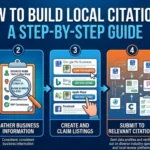
Step‑by‑Step Process | How to Build Local Citations
1. Standardize Your NAP (Name, Address, Phone)
First, decide on one exact format for your business information:
- Business Name: Use your legal name consistently avoid extra keywords.
- Address: Choose one format (“St.” vs “Street”, suite vs “Ste.”) and stick with it.
- Phone Number: Use the same primary number everywhere to avoid confusion.
- Website URL: Decide whether to use “https://” vs “www” and apply it everywhere.
Write these in a reference document. This becomes the foundation for every future citation you build.
2. Claim Core Major Listings First
Start with platforms that have the greatest influence on local search:
- Google Business Profile The most powerful citation you can make.
- Apple Maps / Apple Business Connect
- Bing Places for Business
- Facebook Business Page
- Yelp and industry‑relevant directories
Completing these fully with description, photos, hours, and categories improves visibility much faster than hundreds of random directory listings.
3. Submit to Data Aggregators
Data aggregators distribute your business info to many smaller directories. Submitting here can help your NAP get broadcasted widely with minimal manual work:
- Data Axle
- Neustar Localeze
- Foursquare
- Acxiom
This submission often takes weeks to months to propagate, but it amplifies your reach.
4. Target Local, Niche & Industry Specific Directories
Once the essentials are covered, concentrate on building citations that truly matter for your niche or city:
- Local Chamber of Commerce directories
- Industry‑specific directories (e.g., TripAdvisor for hospitality, Healthgrades for medical practices, Avvo for lawyers)
- Community business portals and city directories
- Local news websites and event listings that mention your business
These citations matter because they signal topical relevance and local context, which is more valuable than dozens of irrelevant listings.
5. Audit, Fix & Maintain Your Citations
Regularly check for:
- Inconsistent NAP information
- Duplicate listings
- Outdated hours or categories
- Misspellings or old phone numbers
Fixing inconsistent and duplicate citations often moves rankings faster than adding new ones. Staying proactive also prevents data confusion and trust issues with search engines.
Expert Tips for Building Better Local Citations
 Treat each citation like a mini landing page: Complete every field, write a unique description, and add photos where possible.
Prioritize quality over quantity: A few high‑value, relevant citations beat hundreds of low‑authority ones.
Monitor competitor citations: See where competitors are listed and target those sources too.
Avoid outdated mass‑submission tactics: search engines now value accuracy and relevance far more than sheer volume.
Common Mistakes to Avoid
 Using inconsistent NAP details Submitting to irrelevant or low‑quality directories Ignoring core listings like Google Business Profile Letting citations become outdated Treating citations as a one‑time task
Avoiding these will save time and improve your long‑term local SEO performance.
FAQs
Q: Do local citations still matter for SEO?
Yes. Although their role has shifted, citations still validate your business data and contribute to local search visibility, especially the Map Pack.
Q: How many citations should my business have?
There’s no fixed number, but most businesses benefit from high‑quality listings across 20–50 reputable platforms.
Q: Should I fix inconsistent citations first?
Absolutely. Fixing inconsistencies often has a greater impact than building new citations.
Q: What’s the difference between structured and unstructured citations?
Structured citations are directory listings with specific NAP fields, while unstructured mention your business organically in content or blogs. Both help local SEO differently.
Q: Are niche citations more valuable than general ones?
Yes, because they signal industry relevance and can boost your local visibility more effectively than general directories alone.
Final Thoughts
Building local citations isn’t simply a “checklist task.” When done thoughtfully with consistency, relevance, and quality in mind citations become powerful tools that reinforce your local presence and help you rank higher than competitors.
Start with NAP consistency, set up your core listings, and expand into niche and local citation opportunities. Above all, keep your data accurate and updated. That’s the strategy that wins in 2026 and beyond.